A New Website Categorization Experience for Ad Tech, Filtering, and Security
We’ve released a new version of Website Categorization, with a major update to how websites are classified, how quickly results can be retrieved, and how categorization data can fit into advertising, brand-safety, web-filtering, and security workflows.
TL;DR
- What happened: WhoisXML API has released a major Website Categorization update.
- What’s new: Native IAB Content Taxonomy 3.1 classification, faster cached results, richer classification output, and more integration options.
- What it means for customers: Existing customers can keep using the previous version until at least January 21, 2027, while new customers get the new version only.
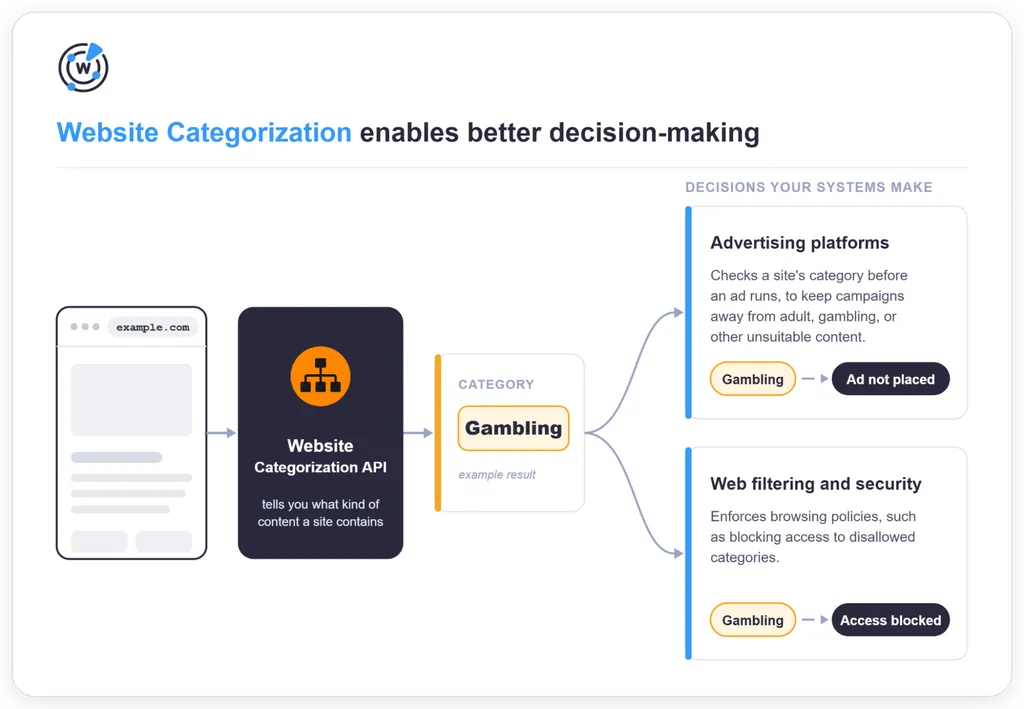
The idea behind website categorization is very simple: it tells you what kind of content a website contains. That seemingly simple piece of information supports a lot of decisions happening behind the scenes every time people browse the web.
An advertising platform may use a website’s category to decide whether it is an appropriate place to show a particular ad, helping keep campaigns away from adult, gambling, or other unsuitable content.
Inside corporate networks, web-filtering and security products can use the same kind of categorization to enforce browsing policies, such as blocking access to disallowed categories.
Our latest Website Categorization release is designed to make those decisions easier to support.
Standardized Categories: IAB Content Taxonomy 3.1
One of the biggest changes is native support for IAB Content Taxonomy 3.1.
The IAB taxonomy provides a common vocabulary for describing website content and is widely used in advertising and brand-safety workflows. Our Website Categorization now classifies content directly using the current version of this taxonomy.
The new release supports:
- All 704 IAB Content Taxonomy 3.1 categories.
- The full four-tier taxonomy structure.
- A primary category plus up to two alternative categories.
- Category IDs, names, taxonomy paths, and confidence values.
For advertising platforms and other systems already built around IAB categories, this means Website Categorization can fit much more naturally into existing workflows.
Faster Responses
When categorization is part of something a user is actively doing, speed matters a lot.
Take web filtering as an example. An employee opens a website, and a security product needs to decide whether corporate policy allows access. If the categorization lookup is too slow, the user may end up waiting for that decision.
The Website Categorization API uses caching to make repeat lookups much faster:
- Cached answers return in under a second.
- A fresh classification usually takes seconds.
- Applications that require a fresh result can bypass the cache.
- Customers can also provide page content directly, such as the title, description, or body text, which skips the website-fetching step and speeds up classification.
More Ways to Use Website Categorization
The new Website Categorization can return more than a single category and supports several ways to use the data depending on the workflow:
- Richer classification output: Get a primary category, up to two alternative categories, confidence information, taxonomy details, and source and freshness data.
- Policy groups: Request 47 policy groups for products such as DNS filters, secure web gateways, and endpoint-security tools that need broader policy-oriented classifications.
- OpenRTB output: Return category information in an OpenRTB-compatible format for advertising and programmatic workflows.
- Prediction sets: Request a set of plausible categories at a selected coverage level when an application needs to account for classification uncertainty.
- Single and bulk API requests: Classify one domain at a time, or up to 100 domains in a single request.
- Bulk data feed: Ingest a weekly snapshot with daily deltas, delivered in compressed CSV and Parquet formats.
A recent full dataset contained 164+ million domain rows, giving customers the option to use real-time lookups or integrate large-scale categorization data directly into their own systems.
What Changes When You Move to the New Version
The new Website Categorization introduces some breaking changes. Existing customers can keep using the previous version until at least January 21, 2027, which gives them time to update their integrations. New customers will have access to the new version only. We recommend updating your integration before January 21, 2027, to avoid disruptions.
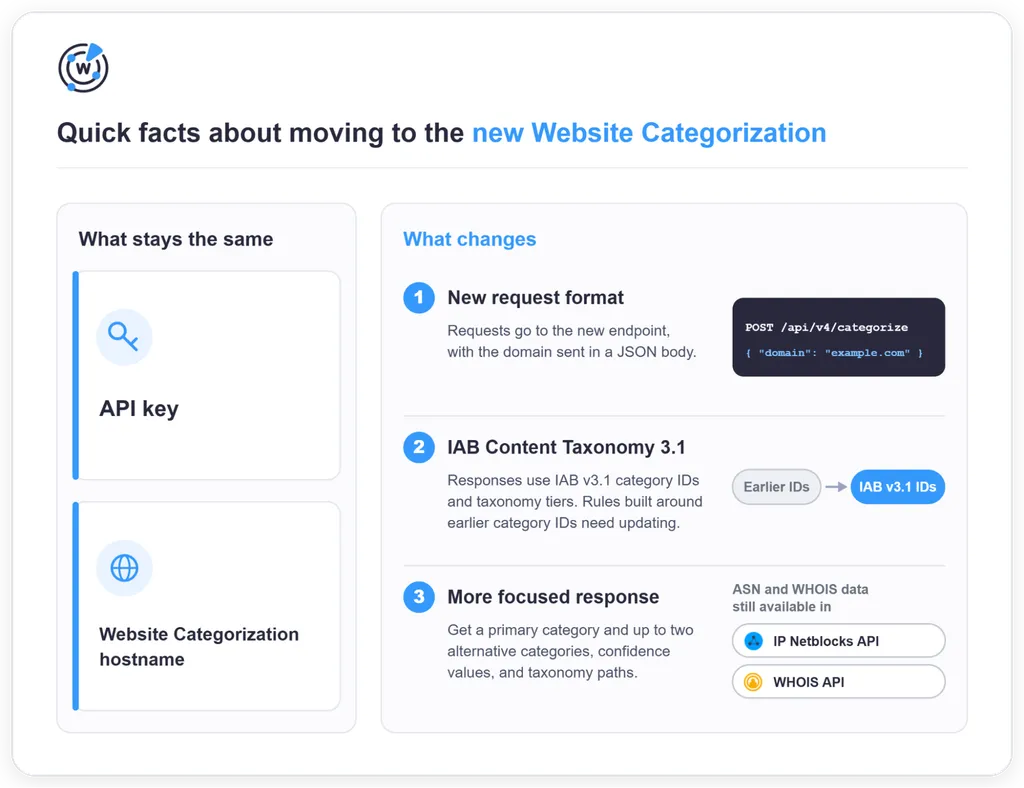
Your API key and the Website Categorization hostname stay the same, but a few things change in your integration:
- New request format: The new Website Categorization uses POST /api/v4/categorize, with the domain sent in a JSON body.
- IAB Content Taxonomy 3.1 categories: Responses use IAB v3.1 category IDs and taxonomy tiers, so integrations built around earlier category IDs will need to update their rules.
- A more focused Website Categorization response: Fields such as ASN and WHOIS creation date are no longer returned by Website Categorization. That information remains available through our dedicated IP Netblocks API and WHOIS API.
Refer to the API docs for more details about the migration.
Get Started with the New Website Categorization
The new Website Categorization is already available and ready to be used in all the different forms: the API, the database, and the web-based lookup.
If you are ready to try it out, you can:
- Sign up to start using Website Categorization.
- Contact us if you have questions about the new release or migration.
Related posts
- How DNS Filtering and Website Categorization Lists Can Empower In-House Cybersecurity Teams
- WhoisXML API Launches Website Categorization API V3
- Know What’s Really Behind A Website With Website Categorization API!
- Malware Detection and Prevention Using Website Categorization API!
- Top 5 Use Cases of WhoisXML API’s New Website Categorization API